A Queue Is Not a Schedule
Architecture · June 11, 2026 · 8 min read
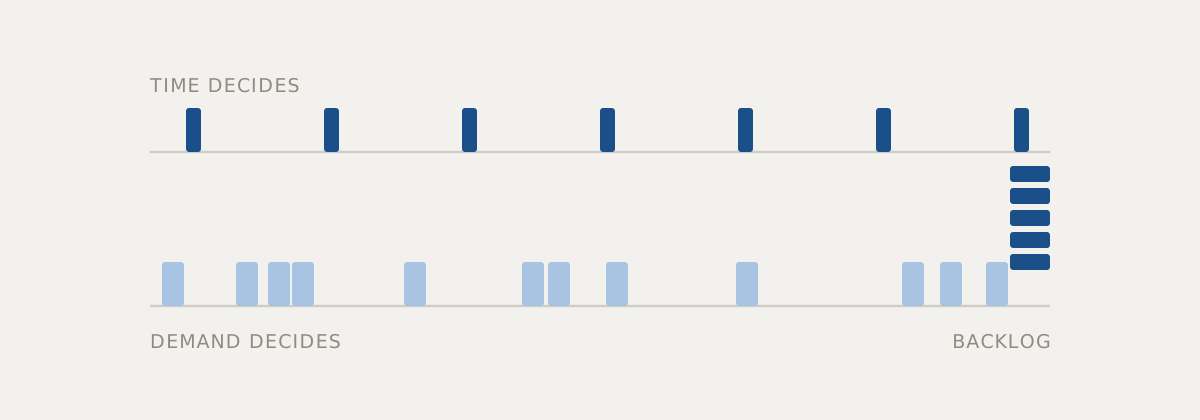
Two mechanisms dominate background work, and they are so often deployed together that people stop noticing they answer to different masters. A scheduler fires because time passed. A queue drains because somebody asked for something. One is driven by the clock, the other by demand, and a system that treats them as interchangeable will eventually be punctual and hopelessly behind at the same time.
What each one actually promises
A scheduler promises initiation. At the appointed moment, something starts. It makes no claim about how long that something takes, whether the previous occurrence has finished, or whether there was anything to do. A nightly job that fires at two in the morning has kept its entire promise the instant it begins.
A queue promises eventual delivery. Each item that goes in comes out, at least once, to some worker willing to take it. It makes no claim about when. If arrivals exceed the rate at which workers can process them, everything still gets delivered, just later and later, and nothing in the mechanism will tell you that has started happening.
Notice that neither promise is about completion within a useful timeframe, which is the thing everyone actually cares about. That gap is where most background processing incidents live.
The overlap problem
Scheduled work has a failure mode that queued work does not: occurrences can collide. A job scheduled every fifteen minutes that occasionally takes twenty now has two copies running against the same data. Sometimes this is harmless. Frequently it is not, and it produces exactly the class of bug that appears once a month, cannot be reproduced, and disappears from the incident log as “transient”.
The fixes are well known and worth stating plainly: take a lock that the occurrence holds for its duration, or make the scheduler skip a tick when the previous one is still running, or design the job so that concurrent copies are harmless because both converge on the same result. What does not work is assuming the interval is longer than the runtime. It was, when the interval was chosen. Data grew.
The backlog problem
Queued work has the mirror-image failure. Nothing collides, because workers take one item each. Instead, the queue silently becomes a buffer for a capacity shortfall.
A queue depth of a few thousand is not itself informative. What matters is whether depth is rising, and how old the oldest item is. Depth answers “how much is waiting”; age of oldest item answers “how late are we”, and lateness is the thing users experience. A queue holding a large but stable number of items that each wait a few seconds is healthy. A queue holding a small number of items where the oldest has been waiting an hour is broken, and the depth metric will not say so.
This is why the instinct to alert on queue length so often produces alerts nobody can act on. Length is a proxy. Age is the measurement.
When time is genuinely the trigger
There are cases where the clock is the real cause and a scheduler is correct. Month-end closes. Regulatory windows. Maintenance intervals expressed in calendar terms. Anything driven by an external cadence you do not control — markets opening, shifts changing, a partner’s file drop.
There are also cases where the clock is a stand-in for an event nobody wired up. “Every five minutes, look for new records and process them” is polling: a scheduler impersonating a queue. It works, it is easy to reason about, and it carries a permanent latency floor equal to the interval, plus a load pattern that is entirely unrelated to demand. Sometimes that trade is right — polling is robust, and it recovers automatically from missed events, which real event delivery does not. But it should be a decision rather than an accident.
When demand is the trigger
Queues suit work caused by something that happened: an order placed, a file uploaded, a sensor reading crossing a threshold, a technician marking a job complete. The work exists because the event exists, and there is no sensible answer to the question “what time should this run”.
Queues also buy something a scheduler cannot: independent scaling of the producer and the consumer. A burst of arrivals does not have to be absorbed by the system that generated them. The buffer takes it. That is the actual value proposition, and it is worth remembering that it is a latency for throughput trade, not free capacity.
The pattern that uses both properly
The most durable arrangement in practice is a queue for the normal path and a periodic reconciliation loop for correctness.
Events go into the queue and are processed as they arrive, with the low latency that implies. Separately, on a schedule, a sweep looks for work in a state that should no longer be possible: items marked in-progress with no live worker, records that were meant to produce a downstream effect and did not, jobs stuck between two steps. The sweep re-enqueues them.
This works because it stops relying on event delivery for correctness. Events get lost — a consumer crashes between receiving and acknowledging, a publisher fails after committing but before publishing, a topic is misconfigured for a week. Any system whose correctness depends on every message arriving exactly once will eventually be wrong, and will have no mechanism for noticing. A reconciliation loop turns lost messages into late messages, which is a survivable class of problem.
The cost is that the loop needs a way to identify work that ought to have happened, which usually means the state lives in a database you can query rather than only in the queue. That is a real design constraint and it is the reason this pattern is more common in systems built after their first serious data-loss incident.
Choosing between them
Ask what causes the work. If the answer names a moment on a calendar, use a scheduler and give it collision protection. If the answer names an event, use a queue and measure the age of the oldest item, not the count.
If the answer is “an event happened, but we only notice on a timer”, you have a polling loop, and the interval you picked is now part of your latency budget whether or not anyone wrote it down.